
European Car Immobiliser Systems in Plain English
You turn the key in your European car, and absolutely nothing happens. A warning light shaped like a padlock or a key flashes on your dashboard. The engine might crank, but it refuses to fire up.
We have seen this specific panic in drivers across Sydney countless times.
It usually is not a mechanical engine failure. The culprit is likely the immobiliser system, which is the electronic security guard designed to stop your car from starting without the correct key.
We want to help you understand exactly what is happening under the hood.
This guide breaks down how these complex systems work, identifies the specific European car tech you are dealing with, and outlines your options to get back on the road.
What Is an Immobiliser?
An immobiliser is an electronic security device that stops the engine from running unless it recognizes the correct key or fob. It operates separately from the physical door locks. A thief might be able to force the ignition barrel with a screwdriver, but the engine will remain dead because the immobiliser cuts off the fuel injection and ignition circuits.
This technology is a standard requirement here.
Australian Design Rule (ADR) 82/00 made engine immobilisers mandatory for all new passenger cars sold in Australia from July 2001. European manufacturers were actually ahead of the curve, with brands like BMW and Mercedes-Benz implementing these systems widely by the mid-1990s.
How the Immobiliser Communication Works
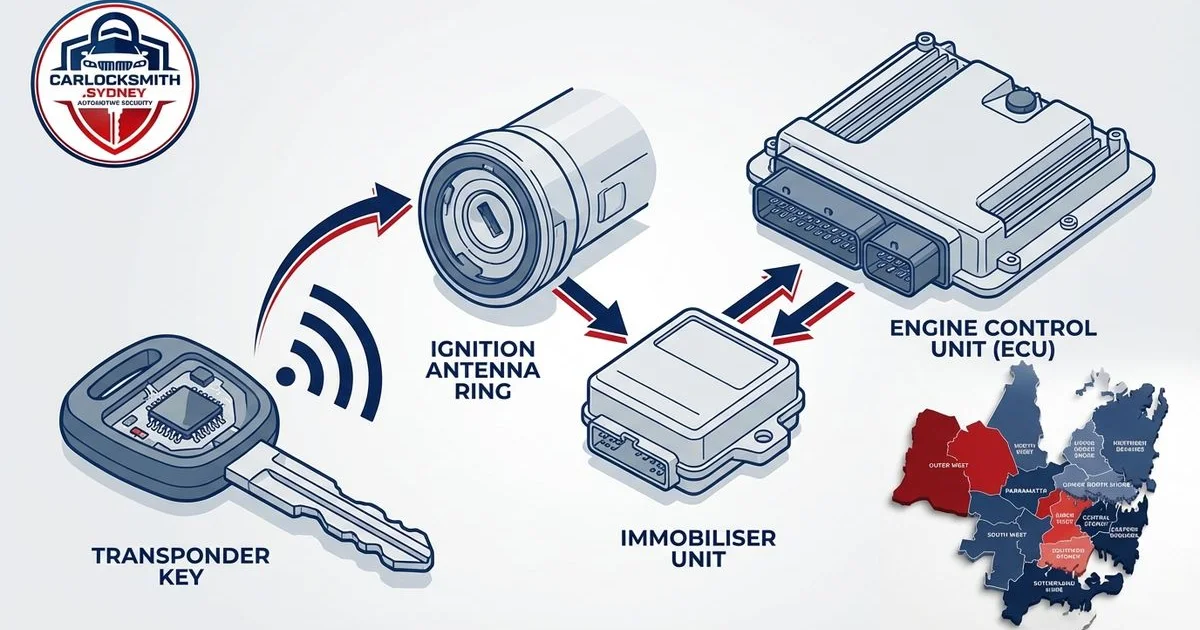
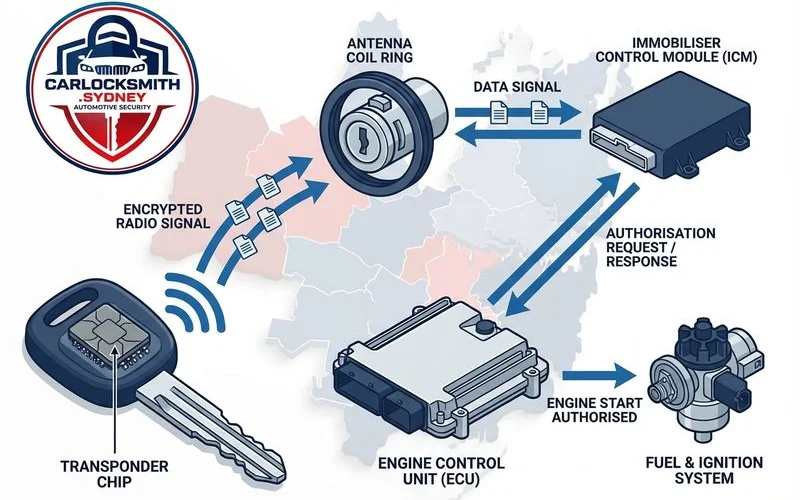
The process is essentially a digital handshake that happens in a split second. We find that visualizing this sequence helps owners understand why their car is silent.
Step 1: Key Detection
You insert your key or bring your smart fob inside the cabin. An antenna coil, which is typically wrapped around the ignition barrel or located in the centre console for keyless entry, wakes up. This coil sends a low-frequency radio signal to the transponder chip inside your key head.
Step 2: The Challenge
The vehicle’s immobiliser module generates a random mathematical question, known as a “challenge code.” It shoots this code over to your key.
Step 3: The Response
Your key’s transponder chip receives the challenge and solves it using a secret encryption key stored inside it. It fires the answer back to the car. This exchange happens via Radio Frequency Identification (RFID).
Step 4: Verification and Start
The immobiliser module checks the answer. If the math matches, the module tells the Engine Control Unit (ECU) that it is safe to proceed. The ECU then enables the fuel pump and spark plugs, allowing the engine to roar to life.
This entire conversation takes less than 800 milliseconds.
Major European Immobiliser Systems
European manufacturers use distinct proprietary technology. Identifying which system your car uses can help you determine the complexity and cost of a repair.
Volkswagen Group (VW, Audi, Skoda, Porsche)
System name: IMMO (Generations 1 through 5)
We encounter VAG (Volkswagen Audi Group) vehicles frequently because their security evolution has been rapid.
- IMMO 3/3+ (approx. 2000-2006): Introduced rolling codes and a PIN requirement for programming.
- IMMO 4 (approx. 2006-2014): Security data moved directly into the ECU with stronger encryption.
- IMMO 5 / MQB Platform (2014-Present): This is the current standard. It uses 128-bit AES encryption and typically requires a connection to the VW factory server (ODIS) for programming.
Insider Tip: On newer MQB models (like the Golf Mk7), the dashboard cluster is a critical part of the security chain. If your digital dash fails, the car often won’t start.
BMW
System names: EWS, CAS, FEM, BDC
BMW systems are highly integrated. The older EWS (Electronic Drive Away Protection) modules are prone to relay failures, while the newer systems are much more digital.
| System Name | Era | Common Failure Point |
|---|---|---|
| EWS | 1995-2004 | Internal relay failure prevents starter motor from cranking. |
| CAS (Car Access System) | 2004-2014 | ”ELV” steering lock failure. The steering wheel stays locked, and the car ignores the key. |
| FEM / BDC | 2014-Present | Software corruption during battery voltage drops. |
The crucial detail with BMWs is the ISN (Individual Serial Number). This 128-bit code must match perfectly between the key, the immobiliser unit, and the engine computer.
Mercedes-Benz
System names: DAS (Drive Authorization System), EIS, ESL
Mercedes-Benz uses a unique “Smart Key” that looks like a plastic fob with no metal blade. These keys use Infrared (IR) light to talk to the ignition switch (EIS), rather than just radio waves.
The “Handshake” Failure: You insert the key, but the steering lock does not disengage, and the dashboard lights do not turn on. This is a classic symptom of an ESL (Electronic Steering Lock) motor failure, which is very common in the C-Class (W204 chassis).
Volvo
System name: CEM (Central Electronic Module)
Volvo routes almost everything through the Central Electronic Module. We often see issues here caused by water ingress, as the CEM is sometimes located in areas prone to leaks from clogged sunroof drains. Programming a Volvo key is notoriously difficult and usually requires removing the module to read the data directly from the circuit board.
Land Rover / Jaguar
System names: KVM (Keyless Vehicle Module)
Modern JLR vehicles rely heavily on the KVM. These modules are sensitive to low battery voltage. If your battery dies completely, it is not uncommon for the KVM to lose its synchronization with the smart keys, requiring a diagnostic reset.
Common Immobiliser Problems
Transponder Chip Failure
The tiny chip inside your key is durable, but not invincible. Glass chips found in older models (pre-2005) can crack if dropped on concrete. Newer carbon wedge chips are tougher physically but can fail electronically due to magnetic exposure or extreme heat.
The Symptom: The engine cranks strongly but never starts. The security light on the dash flashes rapidly or stays solid.
Antenna Coil Faults
The copper coil around your ignition barrel acts as the ear of the system. If the wiring breaks or the connector corrodes, it cannot “hear” the key’s signal.
The Symptom: Intermittent starting. The car starts fine in the morning but refuses at lunch. Tapping the steering column sometimes temporarily restores the connection.
Module Data Corruption
This is a software crash on a hardware level. Voltage spikes are the usual suspect. If you try to jump-start a modern European car incorrectly (sparking the cables), the surge can scramble the binary data inside the immobiliser EEPROM chip.
The Symptom: Complete lockout. No keys work. The dashboard may display “Safe,” “Code,” or simply “Start Error.”
Low Voltage Issues (The #1 Cause)
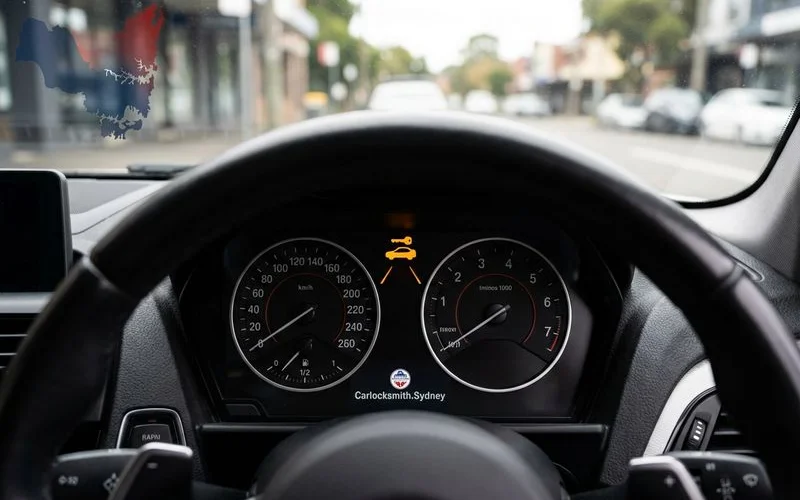
A weak car battery is the enemy of digital security. Electronics require a stable 12 volts to process encryption. If your battery drops to 9 or 10 volts during cranking, the immobiliser module may abort the authentication process to protect itself.
The Symptom: The starter motor clicks or turns very slowly, and the immobiliser warning light flickers.
Key Desynchronisation
Rolling code systems change the password every time you use the key. If you press the unlock button 50 times while out of range of the car (perhaps a child playing with the keys), the key’s math will drift ahead of the car’s math.
The Symptom: The remote central locking stops working first. Eventually, the car may stop starting as well.
What to Do When Your Immobiliser Locks You Out
Step 1: The Spare Key Test
Locate your secondary key immediately. If the spare key starts the engine, you have confirmed the problem is the primary key itself (bad chip or battery). This is the best-case scenario because you can drive to get a replacement.
Step 2: The “Emergency Start” Procedure
Keyless entry fobs often die, leaving you stranded. European cars have a backup failsafe.
Try this: Hold the back of your dead smart key directly against the steering column (look for a key icon) or push the “Start” button with the key fob itself. A passive coil in the car can often read the chip even if the fob battery is totally dead.
Step 3: The System Reboot (Capacitor Discharge)
Computers sometimes just need a restart.
The Reset: Disconnect both battery terminals. Wait 15 minutes. This allows the capacitors in the immobiliser module to drain completely, potentially clearing a temporary logic freeze. Warning: Ensure you have your radio code (if applicable) before doing this.
Step 4: Call a Specialist
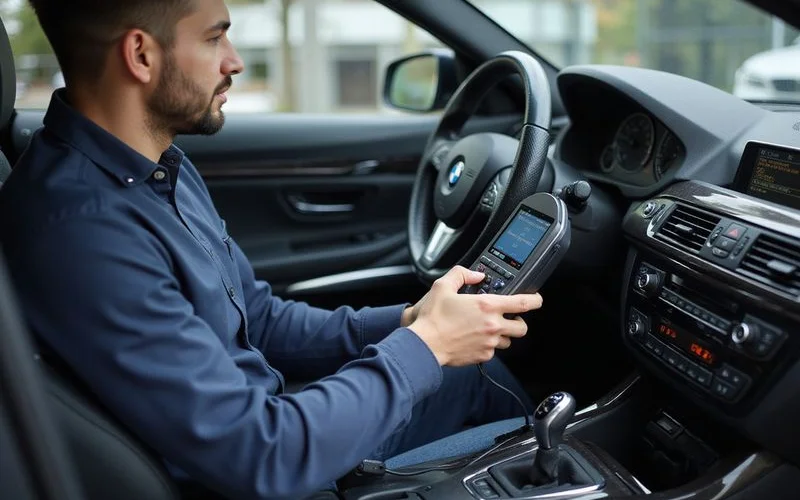
When DIY methods fail, you need professional diagnostics. A general mechanic may not have the specific tools required for European encryption. We utilize dealer-level scanners (like Autel IM608 or OEM tools) to access the immobiliser block data directly via the OBD2 port.
Immobiliser Repair Costs (2026 Estimates)
Repairing these systems can vary in price depending on the severity. Here is what you can expect to pay in the current Sydney market.
| Service | Estimated Cost (AUD) | Note |
|---|---|---|
| Key Replacement (Spare) | $280 - $550 | Cheaper than dealer; price depends on model. |
| All Keys Lost (On-site) | $550 - $1,200 | Includes gaining entry and decoding locks. |
| Antenna Coil Repair | $250 - $450 | Usually involves replacing the ring unit. |
| Module Repair/Cloning | $500 - $1,100 | Fixing a corrupted CAS or EIS module. |
| ECU Immobiliser Programming | $200 - $400 | Re-aligning the codes between modules. |
Key Prevention Tips
- Own a Backup: Getting a spare key made when you have a working one is 50% cheaper than an “all keys lost” situation.
- Watch the Battery: Change your remote fob battery every 2 years. Do not wait for the “Low Battery” warning.
- Keep it Dry: Even a small amount of moisture can corrode the delicate circuit board inside a European smart key.
- Avoid “Faraday” Wallets: Some RFID-blocking wallets are too effective. They can interfere with the key’s signal if the key is attached to the wallet while driving.
Understanding the basics of your immobiliser transforms a scary situation into a manageable one. For brand-specific details, check our guide to BMW and Mercedes key systems. These systems are designed to protect your investment, but they require precise care.
If you are stuck in the Sydney metro area and the dashboard padlock light won’t turn off, we are ready to help you solve the puzzle and get your engine running again.
Looking for this service?
View our european car locksmith service →